CA Role in Board Meetings: Supporting Better Business Decisions
Explore the CA role in board meetings, including financial reporting, risk assessment, compliance oversight, strategic planning, and supporting effective decision-making.
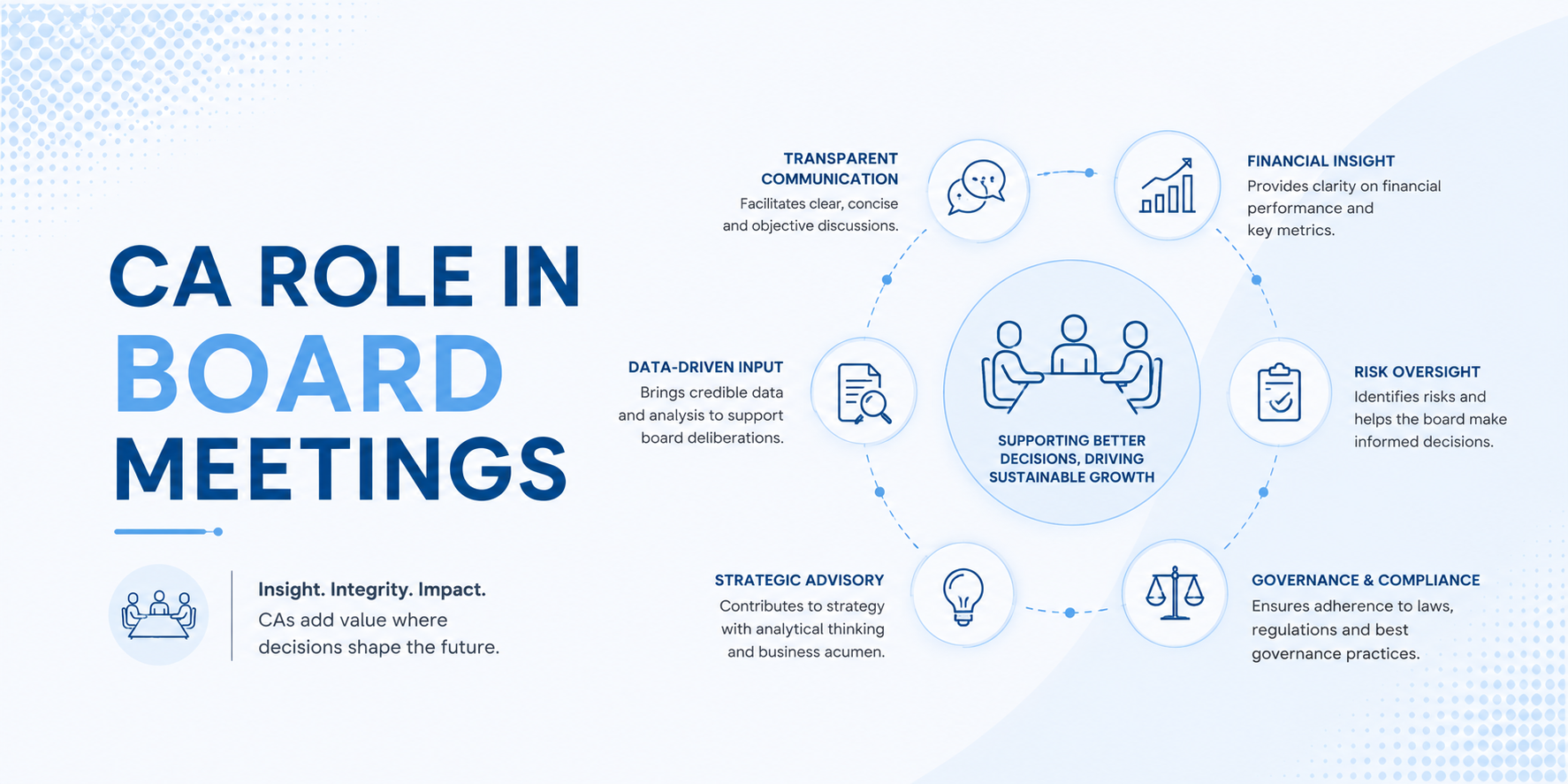
Table of Content
- Why Financial Information Matters in Board Meetings
- The CA Role in Board Meetings Goes Beyond Reporting
- Helping Boards Understand Financial Performance
- Risk Assessment Is Becoming a Bigger Responsibility
- Supporting Strategic Business Decisions
- Governance and Compliance Responsibilities
- Communication Is Just as Important as Technical Knowledge
- Technology Is Changing Boardroom Expectations
- Why the CA Role in Board Meetings Will Continue to Grow
- Conclusion
Board meetings are super important for any organization. They cover major business decisions, strategies, investments, and growth plans. Even though directors and top managers lead, they often need financial advice. That's where CAs come in—they provide key insights. Without CAs, those big calls would be way more risky. So, their input is super significant.
Many folks think Chartered Accountants just focus on making financial reports for the board. But their work goes way beyond that. A good CA actually helps directors grasp the money part of decisions, points out risks, and clarifies issues affecting the company's future success.
With businesses getting more complex, CAs in board meetings are now less about reporting and more about giving strategic advice. Management teams now expect these accountants to share both their technical know-how and real-world business insights, which help in making smart choices.
Why Financial Information Matters in Board Meetings
Every major business decision ends up affecting finances. Whenever a company wants to make moves like acquiring another firm, tapping into new markets, sinking money into tech, or rolling out fresh products, dependable numbers are a must. Assumptions alone can spell serious risk, particularly with hefty investments. That’s why boardroom chats usually fixate on finance-related Q&As.
- Can the company afford the proposed investment?
- What risks could affect profitability?
- How will the decision impact cash flow?
- What return can be expected from the investment?
A Chartered Accountant helps answer these questions by presenting financial information in a clear and understandable manner. More importantly, they help directors see beyond the numbers and understand the broader business implications.
The CA Role in Board Meetings Goes Beyond Reporting
Back in the day, many boards saw financial pros mainly as report-makers and compliance-checkers. Things have shifted a lot. Today, they need people who can read between the numbers, spot trends, and join in on strategy talks. Just dishing out a profit and loss report won't cut it anymore. Directors now want to understand why performance fluctuated and what steps might be needed moving forward. That's where a Chartered Accountant can really add value.
- Explaining financial performance trends.
- Highlighting operational concerns.
- Assessing the impact of strategic decisions.
- Providing recommendations based on financial analysis.
This shift has transformed the CA role in board meetings into a much more influential position within many organizations.
Helping Boards Understand Financial Performance
A CA’s big role in board meetings is making sure directors get the company's finances straight. Many directors don't come from finance backgrounds; they might know ops, marketing, tech, or industry specifics. Therefore, the CAs need to explain financial stuff in simple, practical business terms, not confusing accounting jargon. If profit dropped, directors would likely ask why, seeking clear explanations too.
- Whether the issue is temporary or long-term.
- Which business segments are affected.
- What corrective measures are available.
A Chartered Accountant helps translate financial data into meaningful business insights, allowing the board to make more informed decisions.
Risk Assessment Is Becoming a Bigger Responsibility
Business risks have shot up a lot lately. Now, companies deal with tech issues, cyber attacks, following new rules, shaky economics, and shifting market trends. Board members need to grasp these dangers and put proper defenses in place. This expectation has chartered accountants playing bigger roles in meetings. They often assist boards in assessing all these challenges too.
- Financial risks.
- Compliance risks.
- Operational vulnerabilities.
- Cash flow concerns.
- Internal control weaknesses.
Their ability to identify potential problems before they become major issues makes them valuable contributors to board-level discussions.
Supporting Strategic Business Decisions
A lot of important decisions in board meetings focus on future growth. Companies might think about acquisitions, opening new spots, tech investments, or going global. These choices come with big risks and serious spending. Directors generally want solid analysis and reliable forecasts before giving the green light. That's where a Chartered Accountant helps – they offer dependable numbers and insights.
- Financial forecasts.
- Scenario analysis.
- Investment evaluations.
- Profitability assessments.
This information helps the board evaluate opportunities objectively rather than relying solely on optimism or assumptions. As businesses become more data-driven, this advisory role is becoming increasingly important.
Governance and Compliance Responsibilities
More than ever, corporate governance is in the spotlight. Now, stakeholders want companies to be transparent, accountable, and follow all rules. It's up to the board to meet these high expectations. Chartered Accountants (CAs) really help out here. They assist directors in navigating compliance duties and complex financial reports. CAs pitch in big time in several ways, including:
- Regulatory compliance updates.
- Financial reporting oversight.
- Internal control reviews.
- Governance framework assessments.
Their involvement helps boards maintain confidence in the organization's reporting and compliance processes.
Communication Is Just as Important as Technical Knowledge
One aspect of the CA role in board meetings that is often underestimated is communication. Technical expertise is valuable, but it has limited impact if complex information cannot be explained clearly. Board members need concise, practical, and decision-oriented information.
A successful Chartered Accountant understands how to present financial matters in a way that supports discussion and decision-making. This may involve:
- Simplifying technical concepts.
- Presenting key risks clearly.
- Highlighting important trends.
- Providing actionable recommendations.
Strong communication skills often determine how effectively financial insights influence board decisions.
Technology Is Changing Boardroom Expectations
Technology has transformed how information is presented and discussed during board meetings. Boards now have access to real-time dashboards, advanced analytics, and detailed performance metrics. Directors expect faster access to information and more meaningful insights.
As a result, the CA role in board meetings is becoming increasingly analytical. Today's Chartered Accountants may be expected to:
- Interpret business intelligence reports.
- Analyze performance trends.
- Evaluate data-driven insights.
- Support strategic planning discussions.
Technology provides the information, but professional judgment remains essential for interpreting what that information means.
Why the CA Role in Board Meetings Will Continue to Grow
The business world is getting more complicated. Companies deal with closer looks from investors, regulators, customers, and others, while also juggling data-heavy and risk-prone decision-making.
These shifts ramp up the need for pros who know finance and understand business. So, Chartered Accountants will probably keep playing a key role in boardrooms. With their skills, they aid directors in handling uncertainties and backing solid decisions. Many CAs find that engaging at the board level becomes one of the most impactful parts of their jobs nowadays.
Conclusion
In board meetings, Chartered Accountants do way more than just prepare financial reports. They help boards grasp financial performance and spot potential risks too. Also, they back up governance efforts and weigh strategic options, which aids directors in making smart choices. With businesses getting more complex and stakeholders expecting more, the pros of having that professional financial input have become clearer. Moving forward, CAs will probably dive deeper into discussions about strategy and risk management, working more as business advisors. So, Chartered Accountants will remain crucial for steering organizations toward success.

FAQs
What is the CA role in board meetings?
The CA role in board meetings involves providing financial insights, supporting decision-making, assessing risks, ensuring compliance, and helping directors understand the financial implications of business strategies.
Why are Chartered Accountants important in board meetings?
They provide accurate financial analysis, identify risks, support governance efforts, and help directors make informed decisions based on reliable information.
Do Chartered Accountants only present financial reports in board meetings?
No. Modern Chartered Accountants often contribute to strategic discussions, risk assessments, forecasting, compliance reviews, and business planning activities.
How do CAs support strategic decision-making?
They provide financial projections, scenario analysis, investment evaluations, and profitability assessments that help boards evaluate opportunities and risks.
What role do CAs play in corporate governance?
CAs help ensure financial transparency, compliance with regulations, effective internal controls, and reliable reporting practices that support good governance.
Why is risk management important in board meetings?
Boards must understand financial, operational, and compliance risks before making decisions. Chartered Accountants help identify and evaluate these risks.
How does technology affect the CA role in board meetings?
Technology provides real-time information and analytics, increasing the need for Chartered Accountants who can interpret data and provide actionable insights.
Can Chartered Accountants influence board decisions?
Yes. Their analysis and recommendations often help directors evaluate options and understand the financial consequences of strategic decisions.
What skills are important for CAs participating in board meetings?
Financial expertise, communication skills, business understanding, risk assessment capabilities, and strategic thinking are all important for effective board participation.
What is the future of the CA role in board meetings?
The role is expected to expand further as organizations increasingly rely on financial insights, risk management expertise, and strategic advisory support during board-level decision-making.